
Comparison of all skulls


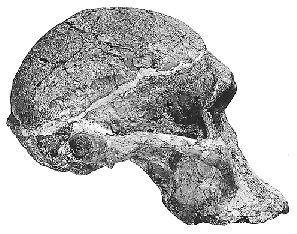


- Chimpanzee, Gorilla
- Sts 5, Stw 53, OH 24, ER 1813
- D2700, Java Man, Peking Man, ER 1470
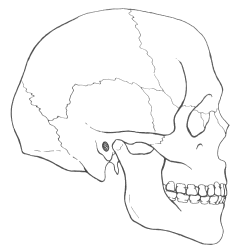
- ER 3733, WT 15000, Petralona, Rhodesian Man, modern human
The skulls on the top row are of modern apes. The skulls on the 2nd row are fossils that (almost) all creationists consider apes, while the ones on the bottom row are (almost) all considered to be humans. The skulls in the 3rd row are ones on which creationists disagree as to whether they are apes or humans. (For ease of comparison, some skulls are reflected so that they all face in the same direction.)
The following table summarizes the diversity of creationist opinions about some of the more prominent items in the human fossil record.
| Specimen | Cuozzo (1998) |
Gish (1985) |
Mehlert (1996) |
Bowden (1981) Menton (1988) Taylor (1992) Gish (1979) |
Baker (1976) Taylor and Van Bebber (1995) |
Taylor (1996) Lubenow (1992) |
Line (2005) |
|
|---|---|---|---|---|---|---|---|---|
|
ER 1813 (510 cc) |
Ape | Ape | Ape | Ape | Ape | Ape | Human ??(2) |
|
Java (940 cc) |
Ape | Ape | Human | Ape | Ape | Human | Human |
|
Peking (915- 1225 cc) |
Ape | Ape | Human | Ape | Human | Human | Human |
|
ER 1470 (750 cc) |
Ape | Ape | Ape | Human | Human | Human(1) | Human ??(3) |
|
ER 3733 (850 cc) |
Ape | Human | Human | Human | Human | Human | Human |
|
WT 15000 (880 cc) |
Ape | Human | Human | Human | Human | Human | Human |
As this table shows, although creationists are adamant that none of these are transitional and all are either apes or humans, they are not able to agree on which are which. In fact, there are a number of creationists who have changed their opinion on some fossils. They do not even appear to be converging towards a consistent opinion. Gish and Taylor both used to consider Peking Man an ape and 1470 a human, but now Gish says they are both apes, and Taylor says they were both humans. Now we're even seeing the phenomenon of creationists who can't quite decide if an individual skull is human or ape - and yet they're quite sure it can't be an intermediate (see the footnotes for examples).
Interestingly, widely differing views are held by two of the most prominent creationist researchers on human origins, Gish and Lubenow. Bowden, who has also written a book on human evolution, agrees with neither of them, and Mehlert, who has written a number of articles on human evolution in creationist journals, has yet another opinion, as does Cuozzo in his 1998 book on Neandertals, as does Line in a 2005 article reviewing the hominid fossil record. Cuozzo has taken the most extreme stance yet for a young-earth creationist, saying that even H. erectus fossils (in which he includes the Turkana Boy) should not be considered human. (Old-earth creationist Hugh Ross takes an even more extreme stance, claiming that not even Neandertals should be classified as human.)
It could be pointed out that evolutionists also disagree on how fossils should be classified, which species they belong to, etc. True enough. But according to evolutionary thinking, these fossils come from a number of closely related species intermediate between apes and humans. If this is so, we would expect to find that some of them are hard to classify, and we do.
Creationists, on the other hand, assert that apes and humans are separated by a wide gap. If this is true, deciding on which side of that gap individual fossils lie should be trivially easy. Clearly, that is not the case.
ER 1813 (H. habilis?, 510 cc) is almost totally ignored by creationists, but it is safe to say that they would all classify it as an ape (which was true until Line 2005). Few mention ER 3733 (H. erectus, 850 cc) either, but those who do seem to consider it human (although it's hard to be sure in Bowden's case).
As one would expect given its essentially human skeleton, virtually all creationists consider the Turkana Boy to be human, although Cuozzo has been a recent exception. (Cuozzo recognizes that it is different from any modern ape, of course; he believes that apes have degenerated from Homo erectus, just as he believes that modern humans have degenerated from Neandertals.)
It would be fascinating to know what creationists think about fossils such as OH 12 (H. erectus, 750 cc), Sangiran 2 (H. erectus, 815 cc), OH 7 (H. habilis, 680 cc), OH 13 (H. habilis, 650 cc), but unfortunately few creationists even mention these fossils, let alone discuss them in any depth.
The recently-discovered Dmanisi skulls overlap the erectus/habilis boundary so perfectly that creationists have almost totally ignored them. The two that have addressed them, however, disagree: Line considers that all the Dmanisi skulls belong to the same (human) population, while Lubenow (2004), bizarrely, considers the largest skull to be human while the smaller two are apes (although there's no discussion of the fossils; those verdicts are buried in the fossil tables at the back of the book).
Footnotes
1. In the 2nd edition of Bones of Contention (2004), Lubenow is not quite as certain as before that ER 1470 is human, stating (p.310) that "[ER 1470] has a cranial capacity of 800 cc and may well be human." He ends his discussion of the fossil (p.329) with: "Having said all that, I have still put a question mark by it. What we can say at the present time is that there is no compelling reason why it could not be human." In other words: he can't tell! Return to text
2. Line quotes from Wolpoff's Paleoanthropology (1999) which talks about the similarities between ER 1813 and Homo erectus, and concludes "If the evaluation of KNM-ER 1813 by White and Wolpoff is correct, then this cranium, with a cranial capacity of only about 509 cm3 may have belonged to a very small human." Which means, presumably, there's also a possibility it didn't belong to a human. In other words: he can't tell! Return to text
3. Line says of ER 1470: "Although a gorilla skull has been found with the same cranial capacity (752 cm3) as that of KNM-ER 1470, the cranium of the latter is much more likely that of a human than an ape." I.e. there's a possibility it belongs to an ape, which means: he can't tell! Return to text
References
Baker S.: Bone of contention: is evolution true?, Evangelical Press, 1976Bowden M.: Ape-men: fact or fallacy? Bromley,Kent:Sovereign, 1981. Ed. 2
Cuozzo J.W.: Buried alive: the startling truth about Neanderthal man. Green Forest, Arkansas: Master Books, 1998, p.101
Gish D.T.: Evolution: the fossils say no, San Diego:Creation-Life Publishers, 1979. Ed. 3 (this is the third edition of a book first published in 1972 and was somewhat out of date by 1979)
Gish D.T.: Evolution: the challenge of the fossil record, El Cajon, CA:Creation-Life Publishers, 1985.
Line, P.: Fossil evidence for alleged apemen, Technical Journal 19(1):22-42, 2005.
Lubenow M.L.: Bones of contention: a creationist assessment of human fossils, Grand Rapids,MI:Baker Books, 1992.
Lubenow M.L.: Bones of contention (2nd edition): a creationist assessment of human fossils, Grand Rapids,MI:Baker Books, 2004.
Mehlert A.W. : Australopithecus and Homo habilis - pre-human ancestors ? Creation Ex Nihilo Technical Journal, 10.2, 219-40, 1996.
Menton D.N.: The scientific evidence for the origin of man, 1988. (a creationist essay)
Taylor P.S.: The illustrated origins answer book, Mesa,Arizona:Eden Productions, 1992. Ed. 4
Taylor P.S.:Who's who and what's what in the world of "missing" links?, 1996
Taylor P.S. and Van Bebber M.: Who's who and what's what in the world of "missing" links?, 1995 (an earlier version of Taylor 1996)
This page is part of the Fossil Hominids FAQ at the talk.origins Archive.
Home Page |
Species |
Fossils |
Creationism |
Reading |
References
Illustrations |
What's New |
Feedback |
Search |
Links |
Fiction
http://www.talkorigins.org/faqs/homs/compare.html, 10/28/2008
Copyright © Jim Foley
|| Email me 